
Checking Criminal History in Tallahassee
The best starting point depends on whether the reader needs a police narrative, a current booking, a filed charge, or a statewide history. Tallahassee has no single city database that merges all four. Start with facts such as the event location, date, report number, and agency name, then move through the custodians only as far as the question requires.
- Identify whether TPD, FSU Police, FAMU Police, Capitol Police, LCSO, or another agency handled the event.
- Request the incident or arrest report from that agency. For TPD records, use its online, phone, fax, mail, or counter channel.
- Check LCSO when a Tallahassee arrest led to admission at the Leon County Detention Facility.
- Search Leon Clerk once prosecutors have filed a County Court or Circuit Court case.
- Use FDLE for a Florida public criminal-history search or personal record review when a statewide result is needed.
Each step has a different scope. The TPD file explains the city police event; the jail entry documents custody; the clerk docket shows what prosecutors filed and how the court acted. The broader Leon County criminal history overview explains county and state checks beyond the Tallahassee route.
Tallahassee Criminal Records Cross Jurisdictions
Tallahassee is both Florida's capital and the home of two major universities. TPD handles ordinary city calls, but an event on or near FSU, FAMU, the Capitol, or state property may belong to another police custodian. LCSO also works within the city through detention and judicial services. The logo on a patrol vehicle, the agency shown on a citation, or the location of the event can prevent a request from going to the wrong office.
The U.S. Census Bureau's Tallahassee and Leon County profile provides official geographic context for the capital and county.
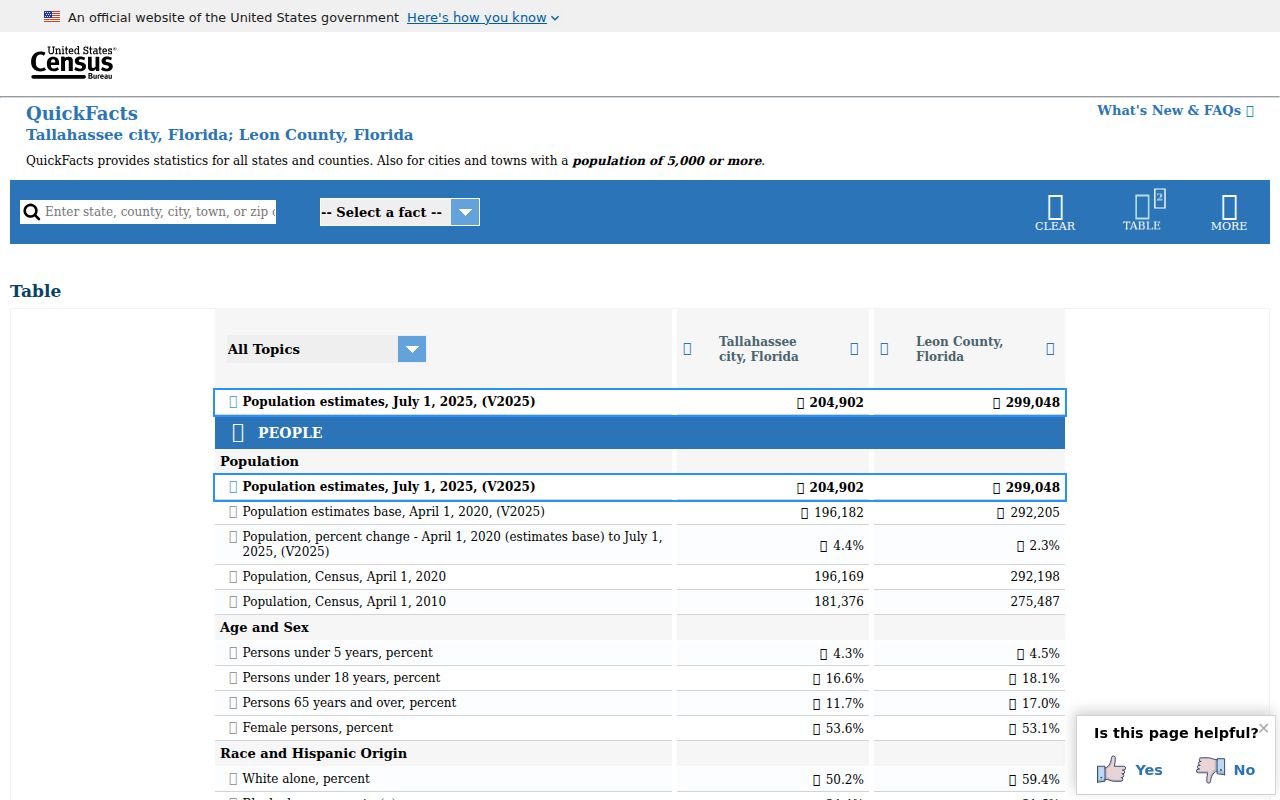
That city-and-county comparison helps keep Tallahassee statistics separate from data for unincorporated Leon County, a key distinction when interpreting local records.
Tallahassee Police Department Records
TPD's Records Unit supplies calls for service, incident and arrest reports, and crash reports created by Tallahassee police. The unit is at 234 East 7th Avenue, Tallahassee, FL 32303. Requests may be made online, by telephone at 850-891-4221, by fax at 850-891-4556, in person, or by mail addressed to Records. Email contact is available at tpdpublicrecords@talgov.com.
The City of Tallahassee's official police page identifies the municipal department and its public-safety services.
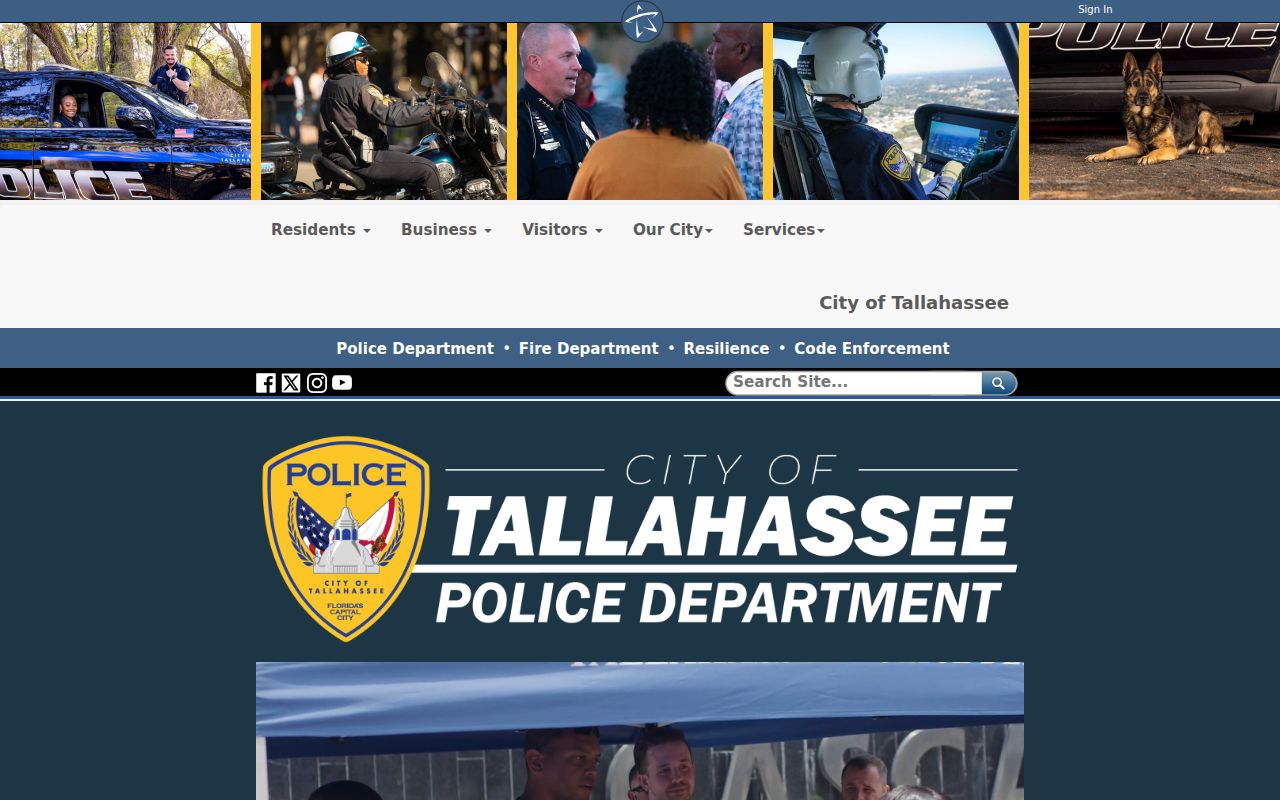
The city page is the proper starting point for confirming current TPD channels before sending a report request.
Build a Useful Tallahassee Police Request
Florida law does not require a requester to give a name or explain a purpose, but TPD still needs enough detail to find the record. A meaningful request narrows the event without guessing. The report or incident number is strongest; otherwise use a precise location and date range. A name can help when it is truly connected to the event.
| Request field | How it helps TPD |
|---|---|
| Record category | Separates a call for service, incident or arrest report, and crash report. |
| Incident or report number | Points to the specific Tallahassee police file when known. |
| Event location | Allows a search by address, business, or intersection. |
| Date or range | Limits the period staff must review. |
| Involved name | Adds another identifier when the name is relevant and known. |
| Format and delivery details | Tells staff how to prepare and send an electronic or paper response. |
This specificity also helps separate a Tallahassee event from a similarly named person or unrelated call. Broad requests can require clarification or more staff review.
Tallahassee Arrests and Bookings
When TPD arrests a person who is held, booking occurs at the Leon County Detention Facility, 535 Appleyard Drive, rather than a separate Tallahassee city jail. TPD retains the police report. LCSO creates the booking and custody record, and its current-inmate search can show people who remain in custody. Release may cause a current result to disappear, so the inmate search should not be treated as a lasting city arrest archive.
If prosecution follows, Leon Clerk later opens the court file. The intake charge, filed charge, and final disposition can differ. Readers focused on custody can use LCSO, while those tracing charges should use the Leon County criminal court case search after filing.
TPD Report Versus Leon Booking Record
A single Tallahassee arrest can create several records in a few hours, but they do not duplicate one another. Matching the source to the question reduces false conclusions about what a missing result means.
| Channel | Primary content | Best use |
|---|---|---|
| TPD Records Unit | Call, incident narrative, arrest report, and agency-created material | Understanding what Tallahassee officers documented |
| LCSO detention | Intake, current custody, booking, and release information | Checking whether an arrest led to county detention |
| Leon Clerk | Filed charges, docket events, disposition, and sentence | Following the court case after prosecution begins |
| FDLE | Reportable Florida arrest cycles and received dispositions | Reviewing statewide public history or one's own state record |
No result in one channel proves that the other records do not exist. Timing, release from custody, filing decisions, and agency boundaries can each explain the gap.
Municipal Court Records in Tallahassee
Tallahassee does not operate a standalone municipal criminal court of record with its own public case portal. Relevant local ordinance, misdemeanor, and criminal-traffic matters run through Florida's county court structure. Leon County Court handles those matters, while Second Judicial Circuit Circuit Court handles felonies. Leon Clerk is the docket and case-file custodian for both levels.
| Court Name | Leon County Court for misdemeanors, criminal traffic, and relevant local ordinance matters; Second Judicial Circuit Circuit Court for felonies. |
|---|---|
| Case Types Heard | County-level misdemeanor and criminal-traffic cases, local ordinance matters, and felony cases at Circuit Court. |
| Case Lookup Channel | Leon Clerk Court Records search, the Clerk counter at 301 South Monroe Street, or 850-606-4000 for assistance. |
| What the Docket Shows | Case number, parties, filed charges, progress-docket events, pleas, judgment, sentence, warrants or capias, and financial events where public. |
| Copies & Fees | Use the Clerk's court-record request process for document images or certified copies; confirm the applicable charge with the Clerk. |
No Separate Tallahassee Criminal Court Portal
A search for a "Tallahassee municipal court" can send readers toward a system that does not exist. City ordinance cases do not stay in an independent Tallahassee criminal docket. Search the Leon Clerk portal by name or case information, call the Clerk, or visit its courthouse counter. Ask TPD for the underlying police report because that narrative does not become interchangeable with the clerk docket.
The official TPD Records Unit page explains the city channel that complements Leon Clerk's county court search.
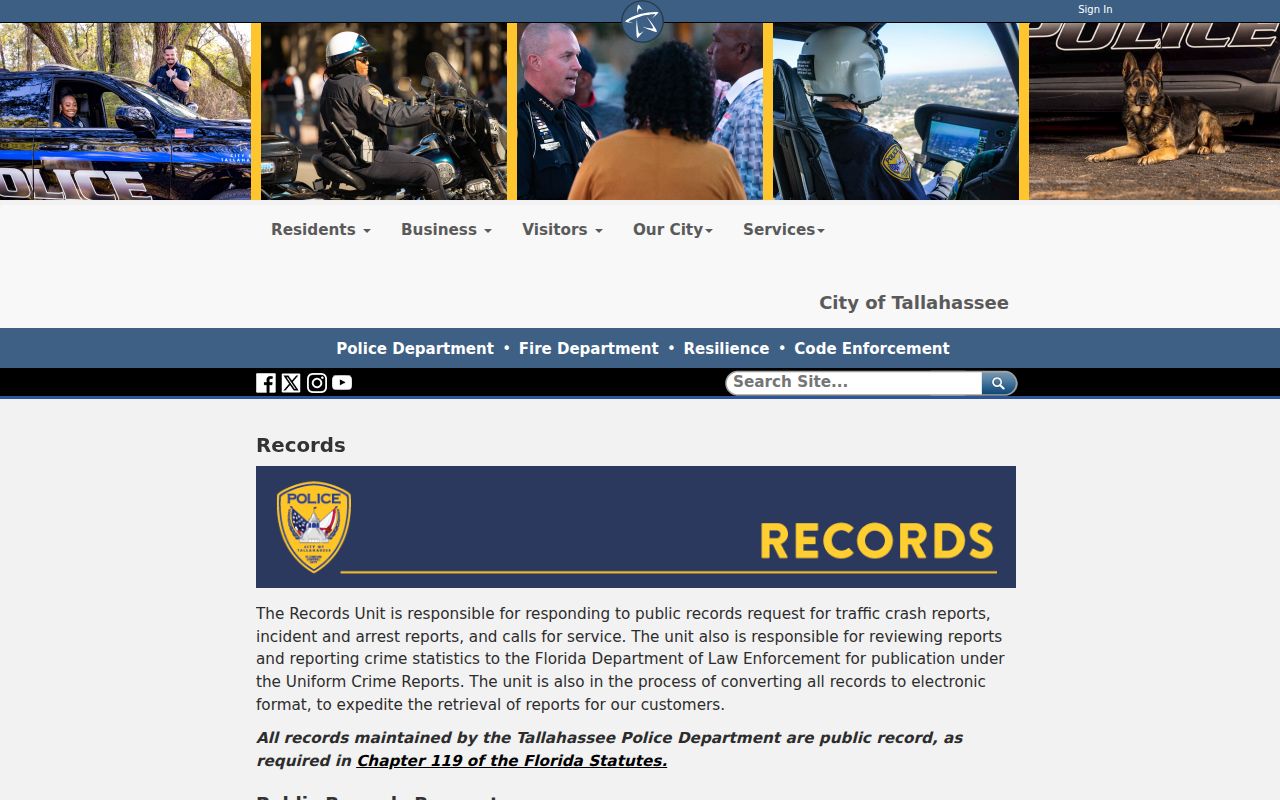
The city record and county case channels work together: one preserves the police event, while the other shows the prosecution and court outcome. Keeping both file numbers makes later comparison easier when an arrest charge changes before the prosecutor files a case.
Where Tallahassee Records Go
A TPD arrest report begins with city police. If detention follows, LCSO creates a separate booking file. The State Attorney for the Second Judicial Circuit decides whether and what to charge, and Leon Clerk maintains the resulting County or Circuit Court docket. Fingerprints and reportable arrest-event data also move to FDLE, with dispositions expected to follow later.
Record flow: Tallahassee Police Department › Leon County Courts › Florida Department of Law Enforcement
For a very recent event, TPD or LCSO may have information before a case exists at the Clerk. For an older matter, the docket is stronger evidence of the filed charge and outcome. FDLE's public history is statewide but does not replace the underlying Tallahassee report or complete Leon court file.
Tallahassee Calls Can Precede Final Reports
TPD's public-safety feed is delayed by about 15 minutes, and initial dispatch wording may differ from the final police report. A call entry confirms that dispatch recorded activity; it does not establish that officers made an arrest or reached the same conclusion suggested by an early call description. Calls for service can be searched using a specific Tallahassee address and date, a business, or an intersection.
If a call appears but the report is not ready, retain the location and time, then ask TPD for the incident number or make a focused records request. Waiting for the completed agency record is more reliable than treating live-feed language as a final finding.
Tallahassee Record Payment Follows a Quote
The separate TPD payment page comes after the Records Unit has reviewed a request. Do not begin there. Staff first supplies the request amount and Request ID. The payment form then asks for those items along with email, billing identity and address, card details, and acknowledgment of its terms.
The official TPD records payment page shows the fields used after a quote and ID are issued.
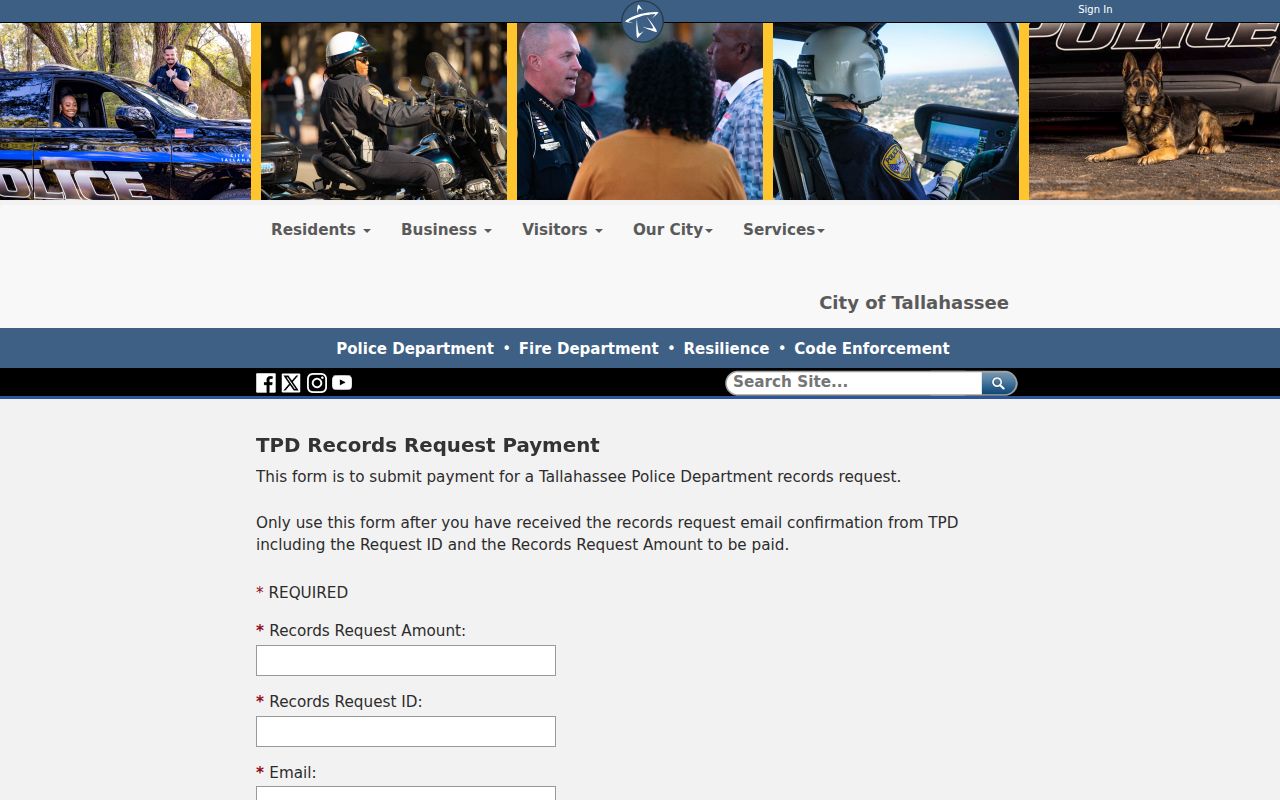
That order prevents payment details from being submitted before TPD has located the Tallahassee record and calculated the amount tied to the request.
Public Access Rules in Tallahassee
Tallahassee police records are governed by Florida's broad public-access framework, but broad access does not make every part of every file public. Active-investigation information, confidential sources, protected personal information, juvenile material, sealed or expunged records, and other statutory exemptions can require withholding or redaction. The custodian should identify the legal basis when an exemption applies.
Key Statutes:
Florida Public Records Law, Chapter 119 gives access to public agency records while preserving exemptions created by law.
Florida Statutes section 943.053 governs dissemination of criminal justice information from the state repository.
Florida Statutes section 943.0585 sets the process and limits for court-ordered expunction.
Florida Statutes section 943.059 addresses court-ordered sealing of qualifying records.
Requesters may ask for Tallahassee public records anonymously and do not need to state a purpose. They still need to describe an identifiable record. When part of a report is exempt, ask whether a redacted copy of the remaining public material can be released.