
Leon County Arrest History
Leon County has an unusually broad set of arresting agencies because Tallahassee is both the county seat and state capital. The Leon County Sheriff's Office handles county patrol, warrants, and the detention facility. Tallahassee Police Department handles ordinary city calls and arrests. Florida State University Police and Florida A&M University Police serve their campuses. Florida Highway Patrol, FDLE Capitol Police, and other state or federal agencies may also create records within the county.
The officer's agency owns the incident narrative and arrest paperwork. LCSO detention staff create the booking entry when a person enters county custody. The State Attorney decides whether and what to charge, the Leon Clerk creates the court docket, and FDLE receives fingerprint-backed arrest-event data plus later disposition reports. Those sources can differ for valid reasons because they describe separate stages.
Leon Booking Search at Appleyard
The LCSO Inmate Search is the first stop for a person believed to be in current county custody. The Leon County Detention Facility is at 535 Appleyard Drive and can be reached at 850-606-3500. Search by first or last name, then narrow with ethnicity or gender only when needed. The search is informational and expressly is not a criminal-background check.
| Search field | Type | Use |
|---|---|---|
| First Name | Text | May work alone or with other fields |
| Last Name | Text | Primary narrowing field |
| Ethnicity | Dropdown | Optional result filter |
| Gender | Selection | Male, Female, or Other |
| Disclaimer control | Checkbox/control | Acknowledges the informational limit |
The official custody-search source shows the entry point.
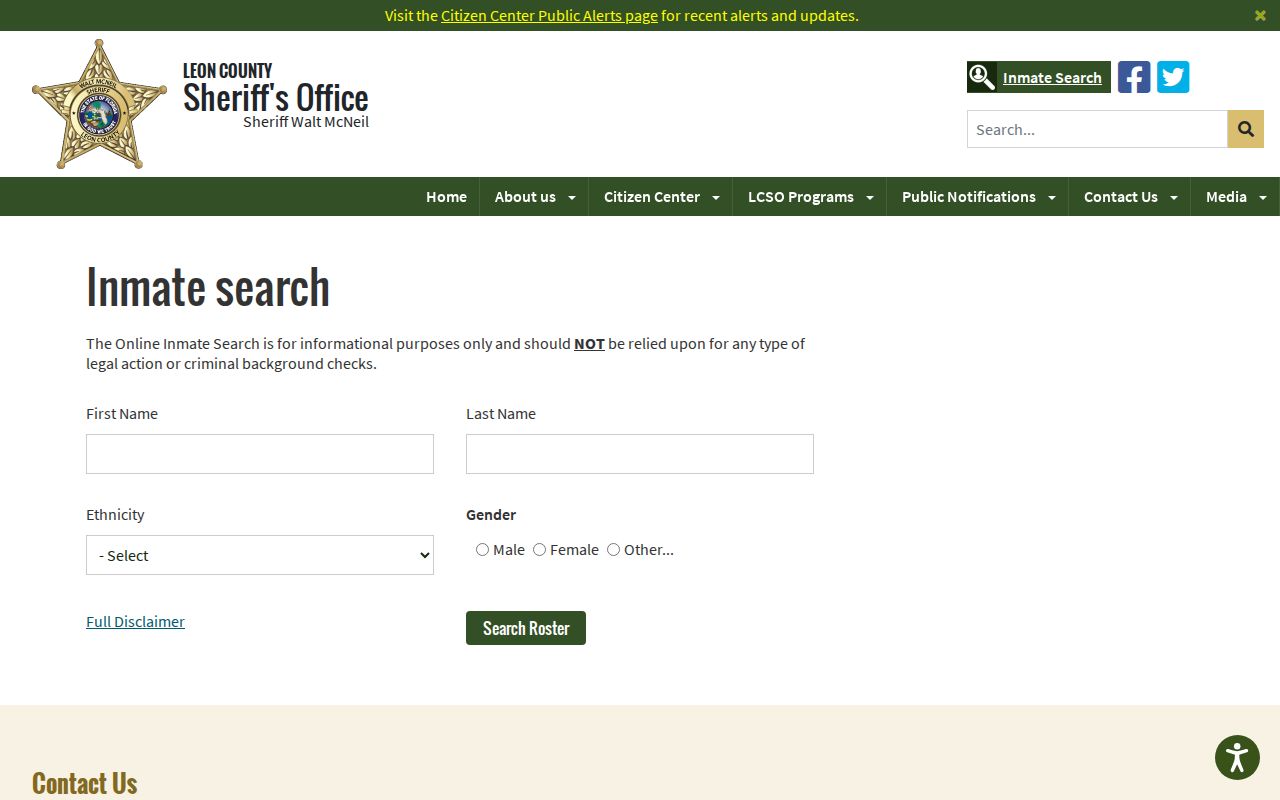
The official search ties a name to present detention data, not a complete history or final case result.
Looking Up Leon County Arrests
No single Leon County arrest lookup covers every stage. Begin with the source closest to the event, then use the next system only for the question it can answer. A recent booking may reach the jail before a prosecution appears in the clerk index.
- Identify whether LCSO, TPD, a campus force, FHP, or another agency made the arrest; if unknown, begin with current inmate search.
- Search LCSO custody by name, or call the detention facility when the web result is unclear.
- Search Leon Clerk criminal cases for charges actually filed and recheck later if the booking is very recent.
- Request the arrest report from the originating agency by online form, phone, fax, mail, or counter where offered.
- Use FDLE CCHInet for a statewide Florida public history, or FDLE personal review when checking your own record for accuracy.
LCSO Records Management accepts sheriff-record requests through the official online submit route, by phone at 850-606-3317, by mail, or in person at 3333 West Pensacola Street, Suite 100. Under Florida Public Records Law, a requester generally need not explain a purpose. State the record type, incident date or range, location, agency, and report or booking number if known. Ask for an estimate before authorizing extensive retrieval.
TPD Report, LCSO Booking, Leon Case
A Tallahassee arrest can produce three county records held by three offices. TPD keeps its officer narrative and arrest report. LCSO keeps the separate Appleyard Drive booking and custody entry. Leon Clerk keeps the judicial case if the State Attorney files a charge. Finding one does not guarantee that another is ready or public.
| Record | Custodian | Best use |
|---|---|---|
| Incident or arrest report | Arresting agency | Probable-cause narrative and event facts |
| Booking entry | LCSO detention | Intake, bond, and current custody |
| Criminal docket | Leon Clerk | Filed charges, hearings, and disposition |
| Florida history | FDLE CJIS | Reported statewide arrest cycles and outcomes |
This split matters around FSU, FAMU, and the Capitol, where the police custodian may not be TPD. Ask which agency number appears on the event before sending a broad request.
Inside a Leon County Arrest Record
An arrest report focuses on the event and legal basis for custody. A booking record focuses on detention intake. Public fields vary with redaction rules and agency policy, but the key items help match the event without treating intake data as a verdict.
| Incident or Booking Number | Agency identifier used to request or match the record. |
|---|---|
| Date, Time & Location | Places the arrest event and detention intake in sequence. |
| Arresting Agency | Identifies the office that holds the narrative report. |
| Alleged Offense | Officer or intake charge, which may differ from the filed count. |
| Bond | Amount or type when public and entered in custody data. |
| Booking Photograph | May be public subject to exemptions and policy; it is not proof of guilt. |
| Custody or Release | Shows detention location or movement when available. |
Victim information, juvenile material, medical data, secure housing details, and other protected fields are not ordinary public booking data. Any denial or redaction should be tied to a legal exemption rather than treated as proof that the full event never occurred.
Leon Arrest Reports Through TPD
TPD Records Unit supplies incident and arrest reports, traffic crash reports, and calls for service. It accepts requests online, by phone at 850-891-4221, by fax at 850-891-4556, by mail, and at 234 East 7th Avenue. Counter hours are Monday through Wednesday and Friday from 8:30 a.m. to 4 p.m., and Thursday from 8:30 a.m. to noon. Email contact is tpdpublicrecords@talgov.com.
A requester need not identify themselves or state a purpose, but the description must permit a meaningful search. Include the report number if known, event address, date or range, record category, and requested format. Calls for service can be searched by an address and date, business, or intersection. A call entry is not the final arrest report, and initial dispatch wording may change after officers investigate.
Do not begin with TPD's payment page. Wait until the Records Unit provides a request amount and Request ID. This prevents payment details from being submitted before staff have located and priced the record.
Booking Logs and Recent Arrests
Leon County does not require a reader to rely on a republished arrest gallery. The official LCSO inmate tool is the current-custody channel. Booking staff enter new arrestees into the Justice Information System, create the jail record, process property, and coordinate later release work. LCSO's annual report describes Booking and Releasing as parts of the detention Operations Bureau.
Release can make a current-inmate result vanish. That change means the person is no longer shown in the active roster; it does not prove that no arrest occurred. Request the booking or arrest material, then search the Leon Clerk for a filed case. Very recent bookings may predate case indexing, so check again or call 850-606-4000.
The official detention visitation and rules source provides facility context.
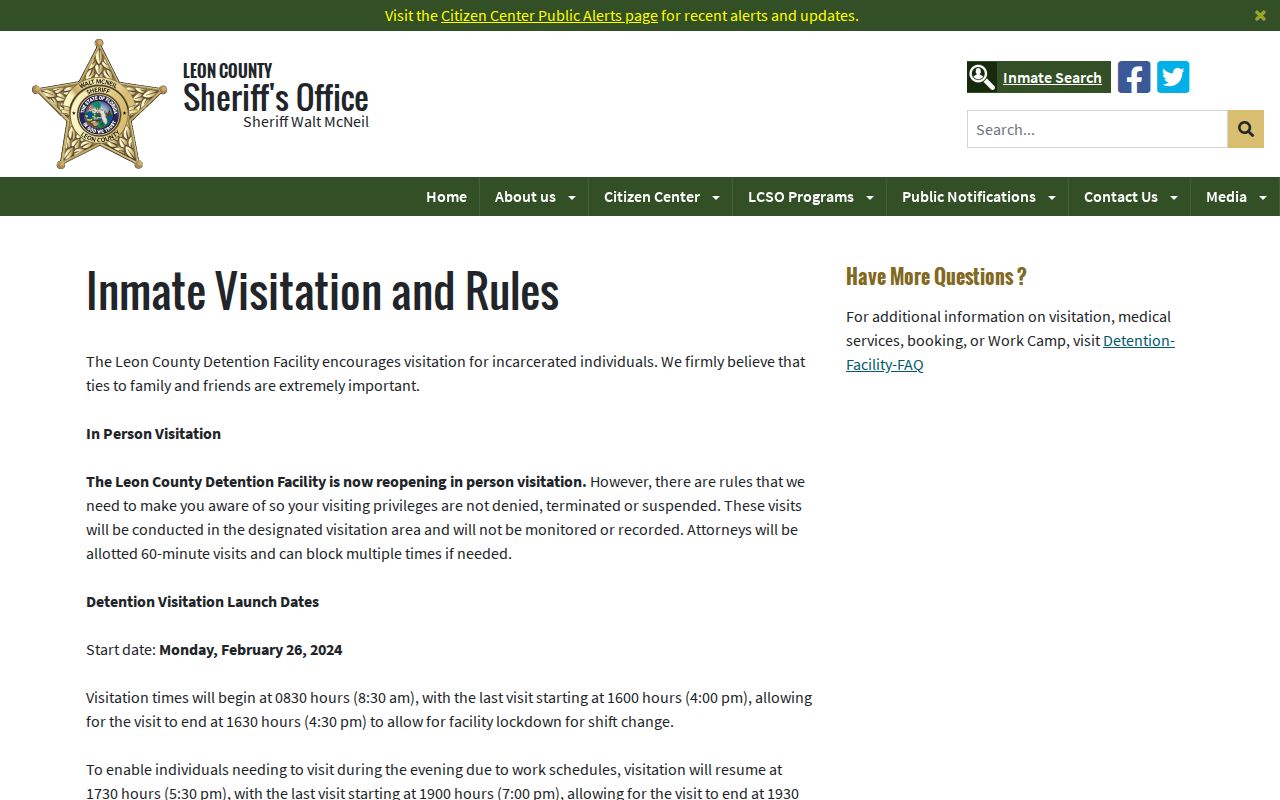
The facility page helps confirm the detention setting while the inmate search remains the proper live custody tool.
Leon Intake Charges May Change
The alleged offense entered at booking captures the arrest stage. The State Attorney may amend it, replace it, file fewer counts, or decline to proceed. The clerk docket therefore controls the public trail of charges actually filed in court. Read each count through its disposition rather than copying the intake label as a final outcome.
A dismissal does not automatically expunge the report or booking entry. Florida sealing makes a qualifying record confidential from ordinary public access, while expunction directs agencies to remove or destroy qualifying records subject to legal exceptions. Both involve separate eligibility and court processes. A missing roster result should never be described as either relief.
Unknown Leon Arresting Agency
When the agency is unknown, first check the LCSO inmate portal if the event is recent and custody is possible. A match should display the arresting agency when that field is available. Next, search Leon Clerk by name and date. A new case number can point back to the charging referral, although it may not yet exist on the day of booking.
If neither source resolves the custodian, narrow the place. Events inside Tallahassee usually point to TPD Records, while FSU or FAMU property may point to campus police. State roads may involve FHP, and Capitol property can involve FDLE Capitol Police. LCSO Records Management can search sheriff-created material but does not become the owner of every report merely because the person was booked at the county facility.
Arrests Are Not Convictions
An arrest documents custody based on alleged facts and legal process. A conviction requires a court result. Because Leon agencies create these records at different times, a booking can exist even when the prosecutor files nothing, the court dismisses a charge, or a trial ends in acquittal. The Leon County criminal court case file is the place to verify filed charges and charge-level outcomes.
| Arrest Record | Conviction Record |
|---|---|
| Created by police and detention staff | Created through the court and maintained by the Clerk |
| Shows that an arrest or booking occurred | Shows a legal finding or plea resulting in guilt |
| Lives with the agency and jail systems | Lives in the court file and reported state history |
| May be followed by release or no filed charge | May lead to sentence, review, or qualifying record relief |
Note: An arrest is not proof of guilt, and many bookings do not end in a criminal conviction.
FDLE CCHInet is a paid Florida repository search, not the underlying police narrative and not a national fingerprint comparison. For review of your own record, use FDLE's personal-review process so identity and disposition errors can be addressed through the official channel.