
Leon County Criminal Court Cases
Leon County divides criminal work between two trial courts at the courthouse complex. The Second Judicial Circuit Circuit Court has felony jurisdiction and handles related postconviction matters. Leon County Court hears misdemeanors, criminal traffic cases, and other county-level proceedings. Tallahassee does not run a separate municipal criminal court of record. Local ordinance matters move through Florida's county and circuit court structure, so a search for a supposed city criminal docket should instead go to the Leon Clerk.
The Leon Clerk of Circuit Court and Comptroller keeps the case file for both levels. A case number, court division, and filing date identify the judicial record. They do not identify the sheriff report or jail booking, which stay with other custodians. The court file begins when a charging instrument reaches the clerk and grows as notices, motions, orders, hearings, pleas, and judgment events are entered.
Leon Criminal Courts Compared
Court level matters because the same portal contains more than one kind of case. Circuit Court is the felony forum. County Court covers misdemeanor, criminal traffic, and county jurisdiction. The State Attorney for the Second Judicial Circuit decides what charge to file, but the Clerk maintains the public docket. Defense counsel may appear in the party section after an appearance is filed.
| Office | Leon County role | Public contact |
|---|---|---|
| Second Judicial Circuit | Felony trials and related postconviction work | 301 S Monroe St; 850-606-4300 |
| Leon County Court | Misdemeanors and criminal traffic | Through the Clerk at the courthouse |
| Leon Clerk | Docket and case-file custodian for both courts | 301 S Monroe St; 850-606-4000 |
The Second Judicial Circuit publishes court administration information, while the clerk portal is the practical record-search channel. Keeping those roles distinct avoids asking a judge's office to perform a clerk records search.
Searching Leon County Case Records
Leon Clerk Court Records is the controlling local portal because Florida has no single comprehensive public trial-court name search. Search broadly first. A party name can locate a matter when the number is unknown, while the exact case number is the cleanest route to a known file. Electronic criminal and traffic information is available except where a case or field is confidential or exempt.
- Open Leon Clerk Court Records and choose name or case-number search.
- Enter the last name, then add the first or middle name only if results are broad.
- Limit results by criminal or traffic type and a useful date range.
- Open the summary and read progress docket entries in date order.
- Use an eligible Request Document checkbox or contact the judicial clerk for copies.
| Field or control | Type | Required | Use |
|---|---|---|---|
| Search by Name | Mode | One mode | Finds a defendant or party |
| Last Name / Business Name | Text | Normally in name mode | Start broad |
| First / Middle Name | Text | Optional | Narrows common-name results |
| Court or Case Type | Dropdown | Optional | Suppresses civil results |
| Date range or year | Date/dropdown | Optional | Limits the filing period |
| Case Number | Separate mode | In that mode | Keep the clerk's punctuation and prefix |
Leon Docket Document Requests
A public docket line and a public document image are not the same thing. Leon Clerk may display the event text while an anonymous visitor cannot open the image. Florida Supreme Court access orders shape which images appear online. Beside an eligible entry, the portal may show a Request Document checkbox. Use it for that specific filing rather than requesting an entire case without need.
If an image is restricted, note the case number, filing date, and exact docket description. Call the judicial clerk at 850-606-4000 and ask whether the record can be inspected, sent as a copy, or provided as a certified copy. Registered online access to additional images requires the clerk's application, which the research says must be signed, notarized, scanned, and returned to the clerk. Older or non-electronic files also require direct clerk help.
Inside a Leon County Case File
The case summary is an index to judicial action. Read it at the count level. One charge may be dismissed while another ends in a plea or trial, and a single overall status can hide that difference. The progress docket places each filing and event in sequence. That chronology helps separate an initial allegation from the charge the State Attorney actually filed and the outcome the court entered.
| Case Number & Court | Identifies the file, division, filing date, case type, and status. |
|---|---|
| Charging Document | An information filed by the State Attorney or an indictment returned by a grand jury. |
| Parties | State of Florida, defendant display, and counsel entries when filed. |
| Docket Entries | Notices, motions, orders, pleas, warrants, hearings, and judgment events. |
| Disposition & Judgment | The result for each count, including dismissal, plea, acquittal, or adjudication. |
| Sentence & Financials | Sentence terms, costs, payments, balances, or collections when publicly exposed. |
Confidential personal data, protected victim or minor information, and sealed matters will not appear like an ordinary adult public file. A blank image field does not prove the underlying filing is absent.
Leon Arrest Charges Can Change
An arrest charge records what officers believed supported custody at that time. It is not the final prosecution. The State Attorney may file a different count, decline a count, or proceed by information after screening. A grand jury may return an indictment in an appropriate case. That is why the docket, not the jail intake line, answers what Leon County actually prosecuted.
Florida disposition terms also require care. A nolle prosequi is the prosecutor's filed choice not to continue a charge at that time. A dismissal ends the charge without a conviction. An acquittal is a not-guilty result after adjudication. Adjudication withheld means the court withheld formal adjudication after a plea or finding; it is not a dismissal. Readers tracing the first custody event can use the separate Leon County arrest lookup, then return to the court docket for the filed outcome.
How a Leon Criminal Case Moves
A Leon County case may start with an arrest, summons, or notice to appear. First appearance addresses rights, probable cause, and release soon after custody. Prosecutor screening follows. The formal case then advances through arraignment, discovery, motions, and pretrial hearings before a negotiated plea or trial. Judgment, sentence, appeal, or postconviction work may add later entries.
Case flow: Charges Filed › Arraignment › Pretrial › Plea or Trial › Disposition › Sentencing
Read the sequence by date and charge. A capias is a court command to take a person into custody, often tied to a failure to appear or later default. A plea is the defendant's response to the charge. Disposition is the event that resolves a count. These terms describe different points in the same court path.
Three Leon Court Roles
The prosecutor, clerk, and public defender serve different functions. The State Attorney for the Second Judicial Circuit screens referrals and files charges for the state. The Leon Clerk receives filings, maintains the docket, and issues copies or certifications. The Public Defender for the Second Judicial Circuit represents eligible defendants but does not serve as the public case-record custodian.
That split points each request to the right office. Ask the clerk for a judgment, docket, or certified disposition. Questions about why a charge was selected belong to the prosecution process, although protected work product may not be public. A defense file is not interchangeable with the public clerk file. Court reporters, rather than the clerk portal, can supply official written transcripts in most felony and county criminal proceedings; certain proceedings use digital recording and may yield audio through the official process.
The manifest's official source captures reinforce those roles. The State Attorney, Second Judicial Circuit, and Public Defender pages identify separate parts of one Leon County case path.
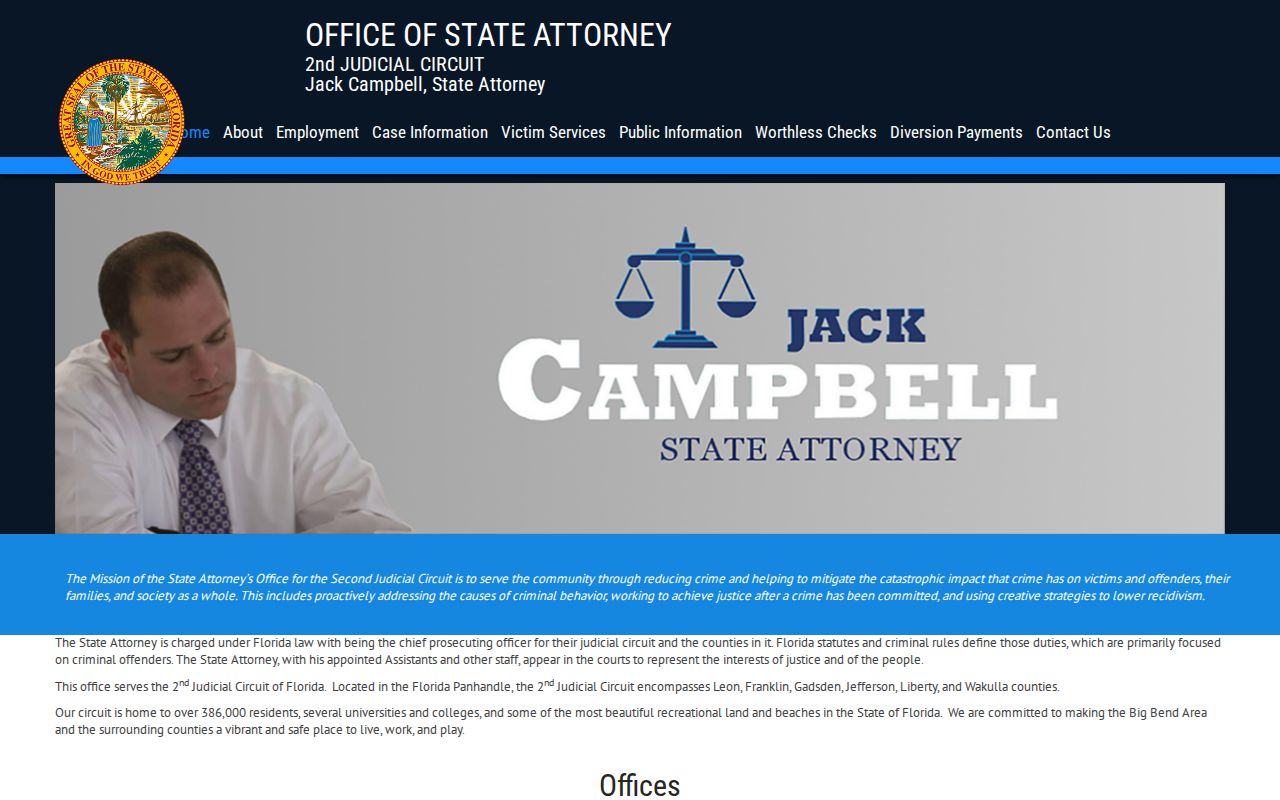
The State Attorney source marks the charging office, not the docket custodian. The Second Judicial Circuit source then identifies the court administration layer.
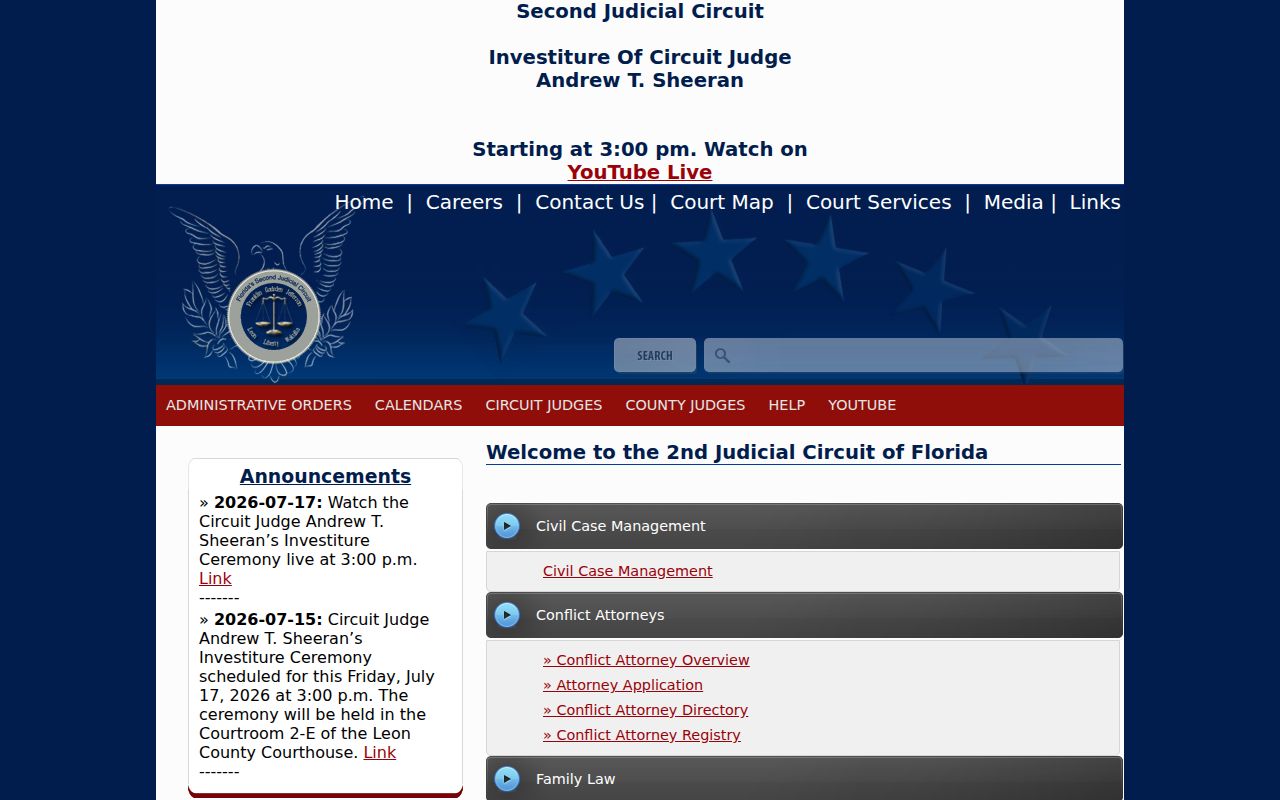
The circuit source identifies the felony court structure serving Leon County. The Public Defender source documents the separate defense office.
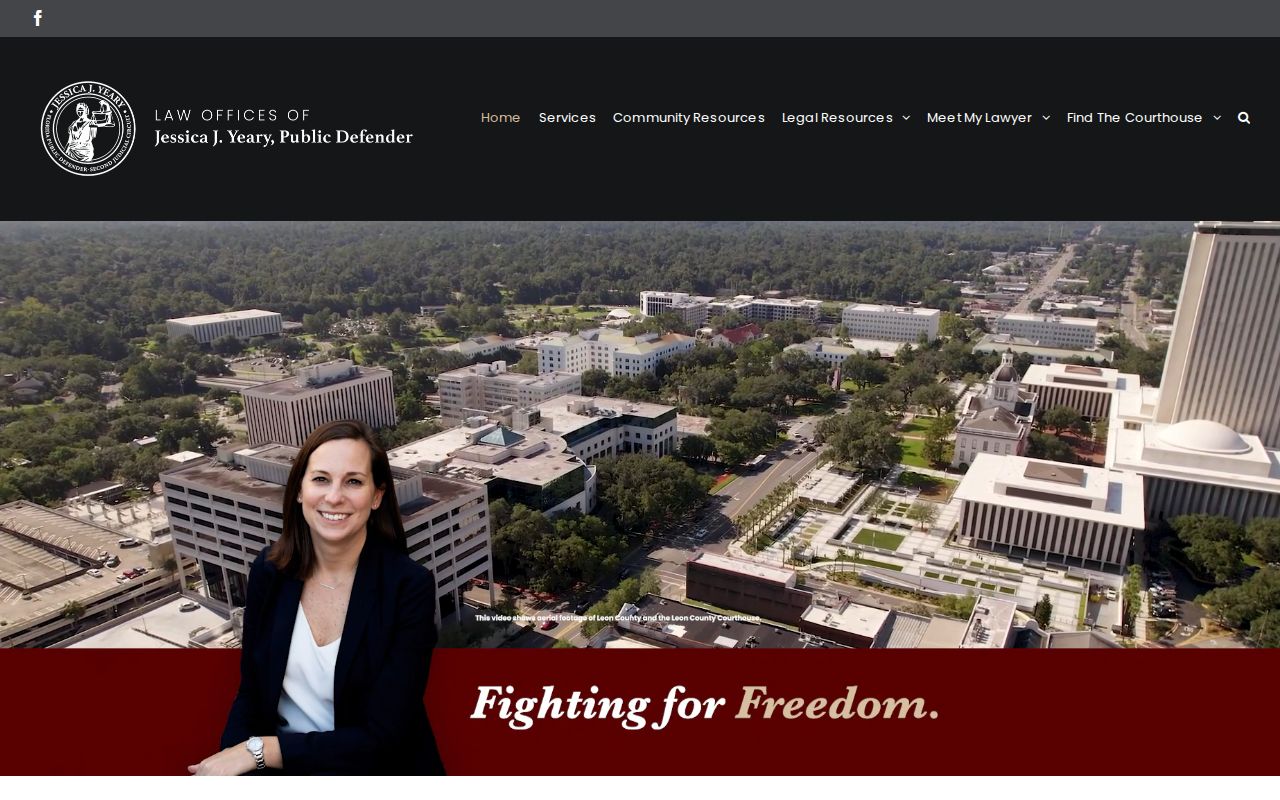
The Public Defender source shows the defense office's distinct role in the same circuit.
Certified Leon Court Records
A screen print is useful for research, but it is not a clerk-certified court record. For a certified judgment or disposition, give the Leon Clerk the exact case number and document description. Ask for the price before ordering. The published Official Records rate should not be assumed to be the criminal-court copy fee unless the Clerk confirms that it applies.
The Clerk's court records guidance is the source for current access instructions.
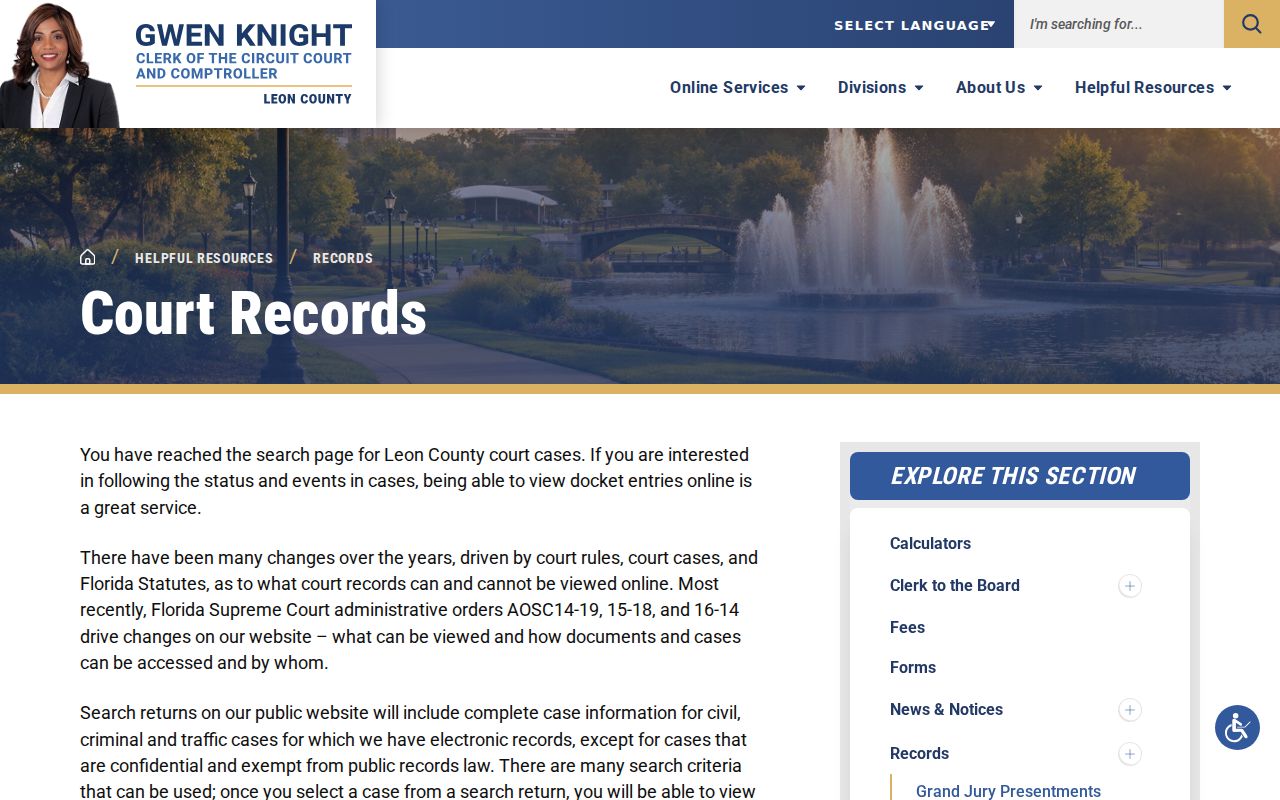
This official clerk page is the best place to confirm the current document-request route before paying for a copy.
Case Record Access & Restrictions
Florida Rule of General Practice and Judicial Administration 2.420 defines public court records and the procedure for confidential material. Florida's constitutional right of access and Chapter 119 support inspection, but exemptions still apply. Juvenile matters, sealed cases, protected victim information, account data, and other confidential fields may be withheld or redacted. Active criminal intelligence held by an agency may also face a temporary exemption, though that agency record is distinct from a filed court document.
If a Leon County case does not appear, check spelling, middle-name variants, date range, and court type. Then call the Clerk. Ask whether the file is older, non-electronic, confidential, sealed, or indexed under another form of the name. Do not treat a negative portal result as proof that no case exists. Likewise, do not assume a restricted image means the whole docket is closed.
Florida sealing preserves a qualifying record under confidentiality. Expunction directs removal or destruction under statutory rules and exceptions. Neither result should be inferred from a failed name search. The court order and clerk confirmation are the sound sources.